Wednesday, August 19, 2015

MTB Test Riding #1

So, I'm starting to shop for a new mountain bike. I honestly don't expect to buy until 2017 (Happy 40th B-day to me!), but so much has changed in mountain bike technology in that past 10 years since I got my last bike, and there are so many options out there today, I'm going to try to get out there and test ride as many bikes as possible to inform my desicsion.

I was just going to write the following in a text file on a computer, but then I said, hey, why not post it on the blog so maybe my thoughts might influence others. Also, easier to find on the blog than a random text file on my computer.

Today was the Giant demo ride day at Cam-Rock. I rode the Athem, Trance and Reign.

Overall Impressions:
  • Disc brakes still aren't that great. The XT brakes on the Anthem and Trance (with 160mm rotors) were very unimpressive, though they matched the modulation of my Avid v-brakes, they had significantly less stopping power than my 15 year old SD Mag's. Once I got on the Reign with the 200/180mm rotors, I'd say the stopping power just about matched the v-brakes on my Soulcraft. Viva la v-brakes!
  • Newer bikes have much more stiff steering than my 10 year old Soulcraft. This was most pronounced on the Anthem which was horizontally stuff and vertically compliant to the point of feeling kind of weird... but it definitely improved bike handling.
  • I think I'm going to want a dropper post (if I want a dropper post) with the ability to pre-set a couple heights. What I really wanted was a XC position like I normally ride in, then about a 1" drop for more technical sections and then maybe a total of a 4" drop for when it really gets vertical. The type of dropper post on the Giants was awkward, you flip the lever on the bars for the dropper post, then you needed to put a little extra pressure on the saddle to compress the post. It would move down pretty fast and suddenly the saddle is way too low to work well as a contact point to help you handle the bike.
  • 27.5" tires didn't really feel all that different than 26" tires. Maybe because I run larger diameter tires 2.4" at lower pressure than the bikes I tested which all ran 2.2" or 2.25" tires. I feel like all these bikes would have worked better with larger volume tires at lower pressure. This would allow for more small-bump compliance and better traction.
  • I liked the Fox suspension products better than the Rock Shox. The Fox bits seemed easier to use, for example the rear shocks suspension firmness adjustment lever was easy to get at and remember which setting was which. The same lever on the Rock Shocks Monarch was hard to reach and impossible to see what setting it was in... you'd just have to memorize it. Also, I'm a bit of a Fox snob after owning some really bad RS forks back in 90's and early 2000's. To be fair, the Revelation fork is not as well regarded as RS's higher end Pike fork.
Reign Advanced 27.5 1: This is their "Enduro" bike with 6.3" of travel in the rear and 130-160mm in the front. I felt like this much travel was useful. The head tube angle was 65-degrees. This was a little ridiculous. Though it felt really smooth and controlled in the berms, and very playful on small drops, it was awkward on the flats and climbs sine the bike wanted to "wander". In fact, the steering kind-of had the habit of oscillating. The bike was also heavy (these guys weighed it at 31.7 lbs) and the suspension ate up a lot of pedaling energy. Lastly, the stem was really short and the bike had a very upright riding position. These four strikes made it a bike that would be fun to ride downhill, but I would really only recommend it when you have a chair lift or pickup truck carrying you to the top of the hill because pedaling it up was not fun.

Trance Advanced 27.5 1: This bike was pretty well rounded, but still the HT angle felt a little to slack and wallowy at 67-degrees. Suspension gave up some energy on the climbs, but if you set the suspension to the stiffest setting (which was a pretty easy flick of the switch) it wasn't bad at all. Still kind-of heavy though, but then again, I'm pretty heavy right now too. These guys say its only 25.8 lbs, but it felt heavier, maybe that weight is sans-pedals. The medium size had great stand over, but the top tube was too short, I would have to go with a 70mm stem (I think the stock was 50mm) and maybe move the seat back a little further.

Anthem Advanced 27.5 1: Bearing in mind that I've been riding around on a bike with a 71° head angle for the past 20 years or so, I felt pretty at-home with the 68.5° head-angle on the Anthem. It definitely helped stabilize things in rock gardens and in berms compared to my Soulcraft. Honestly, I may be OK with a head angle as low as 68° for all-around riding. (UPDATE: This bike may actually have a 69.5° HT angle (Giants geometry charts aren't consistant), which would explain why I felt relatively at home on it.) You could tell it didn't have a lot of travel, 100mm in the back I could use more, but I suppose that's 100mm more than my hardtail. With the suspension set to the firm setting, it actually felt like it had a firmer rear-rend than my steel hardtail (with a Ti seatpost), for better or for worse. The 100mm fork in the front was very laterally-stiff for good control, but was somewhat unimpressive from a soaking-up bumps standpoint, perhaps because I'm used to riding a 100mm fork on my Soulcraft, but perhaps the fork was set up a bit too stiff for me. Size large actually fit me perfectly horizontally, but left me with 1" or less standover clearance, which is not acceptable. Medium would need a longer stem, but I don't see why they can't just make this model with more standover clearance. This bike seems to be marketed as an XC racer, but honestly I think my Soulcraft would be more efficient and work better on all but the most rough courses. These guys say its about 25 lbs, didn't really notice the weight either way, which I suppose is a good thing.

Conclusion:  If I was buying right now, I think I'd either by a short-travel FS bike with a longer travel fork on the front (like the Anthem SX which was not available for a test ride) or a Ti or Steel hardtail with a similarly longer-travel fork. By longer, I'm thinking 110-140mm adjustable fork like a Fox Talas. I think it would be ideal if this allowed me to ride the bike with a roughly 68.5-degree head angle for XC riding and a roughly 67-degree head angle for technical, vertical trails. But Man, I don't like how the Anthem SX is all SRAM 1x11 with a Rock Shox fork. I feel a 2x drivetrain would suite my needs better.
Maybe a 27.5+ bike would work well too, I'll have to find a way to throw my leg over one of those.

Friday, March 27, 2015

Foward Wisconsin: Into the Wind

I began my road riding 'career' in the late 1990's in the flat-as-a-pancake plains of central Illinois. This area is almost nearly treeless, and the corn is only tall enough to provide even a modest wind barrier about 3 months of the year. The roads are paved, nearly traffic free, and arranged in a perfect mile-square grid along the cardinal directions. This makes rides safe and navigation easy, but they could get a little boring, especially when riding solo.

Here, the ride route each day was dictated by one thing: the wind direction. We'd gather up at our meeting point, assess the wind conditions and head out of town, two-abreast, on whichever one of several routes took us as directly into the wind as possible.

This had a couple key advantages:
  1. We could challenge ourselves working into the wind while we were fresh and strong early in the ride, and get a good workout in.
  2. You never found yourself worn-out and stranded too far out of town. If you were questioning your ability to go on, you just turned around and the wind pushed you home.
  3. We could ride in groups with a fairly broad range of fitness levels, since the strong riders could pull on the way out of town while the weaker riders sat in, working less hard and thus keeping up with the group. Often at the turn around the stronger riders would form a race-like group and sprint-chase-tempo their way back into town further challenging themselves. If anyone (or sometimes, just about everyone) got dropped, well they had an easy ride back to town with the wind behind them.
Since then I have lived in a couple locations that had trees, buildings, or both! This has led me to two basic edicts that I follow when planning a ride route. These seem so self-evident to me that I'm pretty shocked by how few Madison riders consider these when planning a ride:
  1. Always head out of town into a headwind.
  2. Choose an outbound route near buildings and trees that exposes you to the minimum amount of headwind, and a return route through open country that exposes you to the least headwind.
Now, riff on this theme to your liking: If you want a hard workout, maybe you want to face down the wind as much as possible on the outbound leg. But my point is: pay attention to the wind!

If you're going to do the Monona Lake Loop, figure out if the wind will be with ya, or against ya on that big open stretch on John Nolen Drive & the Monona Terrace. Heading south into the wind? Use the tree cover on the Badger Trail to get you south of M, and then use Seminole or some other rural road to push you back to town. Head west through town into a wind with cover from buildings, then return east north or south of town with the wind behind you on country roads.

Ride Smart. Don't be a sheep and just ride the same routes the same way all the time. Have fun.

Friday, January 23, 2015

Triple-D 2015: the Warmest, Fastest, Messiest Triple-D yet

I came into the Triple-D this year from a pretty low place. I always intend to train for this race starting in October, or even August, but life gets in the way. In particular, we moved my now 18-month-old daughter into a new daycare in September, and I think I've gotten 5 bouts of colds/flu's from this new 'germ factory' from then through the end of the year.

The end results is that I came into the Triple-D in arguably the worst shape I've been in in my 25 years of riding. Possibly, in Y2K when I pulled my quad and recovered by sitting on the couch eating chocolate chips and watching Star Trek for 3 months and gained 30 pounds was worse. Lately, my legs have been noticeably sore even after a moderately-paced, 2 hour ride which I only seem to get in every other week or so. I wondered, how long it would take until they just give out completely?

So I gave some thought to not attending this year at all, but in the end I figured the worst case scenario was that it would be a 3+ hour ride before I had to call the sag wagon. And getting out for a ride like that would be beneficial, so back I go to Dubuque.

I stayed at my parents cabin in Galena the night before, so I had a nice 45 minute drive to think about the race as I drove into town the morning of. This was going to be (yet another) weird one. High temperature around 40, and a low in the upper 20's. That's 30 degrees warmer than some of the Triple-D's I've ridden in the past. I knew warm temps and melting snow could make for some unpredictable trail conditions. Warmer temps meant I could wear less and pack lighter to be more efficient. But on the other hand, this was a 'I just want to finish' year for me, so maybe I should take extra gear to be ready for any circumstance. In the end I did a little of both, and it worked out fairly well.

This was a big year for the race with something like 120 starters in the bike category and enough runners to push the total participants over 200. Let me tell you, the sound of 240 fat tires rolling down the pavement during the neutral start is quite a cacophony. When we got to the point where we were supposed to separate out into pace groups, instead of people waiting for Lance to send us off as groups (top racers, racers, just-finishers, poker run riders, etc), people just started to take off. Well, when in Rome..., so I got into the mess too, over the tracks and onto the singletrack among the top 20 or so riders.

My race strategy was simple: get near the lead for the start of the race so you're not stuck behind poorly skilled riders or people with too much air in their tires at the beginning (most everyone has too much air in their tires), then once the course opens up take the pace back a bit to something I could sustain for several hours. I actually nailed this plan. At the start and in the singletrack, I didn't have anyone get in my way and I didn't get in anyone else's way. My riding but Tyler had gotten into the fray a few positions ahead of me, but he was off like a rocket and I didn't see him for long.

Once we got out into the open, I started getting passed pretty steadily. Its hard as a long-time racer to let this happen, there's a twinge every time that makes me want to chase, but I stuck to my plan and rode at my own modest pace. Nick passed me in the fairgrounds, and we continued on through old fields, pastures, corn fields, soybean fields and more pastures. Conditions on the ground were pretty good, a mix of firm snow and frozen (but slowly thawing) dirt, and I noted making a couple climbs that had always bee hike-a-bikes in the past.

Then my hip started to bother me. I have a problem in that my SI joint in my hip locks up every few months and makes my IT band very tight and can also screw up my spine alignment a bit. I hadn't been riding enough before race day to notice it was locked up! I started getting shooting pain radiating from my hip down to my knee and starting to go up my spine, so I had to stop just after crossing the road past the fair grounds to stretch it out. I had to stop again 15 minutes later at the top of one of the longest climbs of the race to stretch it again. It was so warm that I was actually choosing places that were open and exposed to the wind to stop and stretch rather than looking for somewhere sheltered like you usually will in the winter.

Well, I may be fat, out of shape and partially crippled, but I still have the skillz. I bombed the next downhill, one of the funnest parts of the course, and then actually managed to ride most of the way up the next hill through the woods, before having to stop and stretch again. Then we were out into one of the biggest open field stretch of the race, which is usually a drifted-in hike-a-bike, but I was able to ride almost all of it.

I used the pavement section that followed to eat a bit and drink, when we turned west on Humpke Rd. into the headwind, I was lucky enough to have a group of riders come up behind me on so I got in the pack and drafted a bit.

Lance the race organizer was in the group, and as we approached the turn off for the gnarly downhill B-road section of Humpke, he said something to the effect of "be careful on the downhill". At this point, I pulled ahead of the group and shouted back to Lance: "you said 'GO FASTER!', Right?! I couldn't be sure about Lance, but there was no doubt in my mind that I would take that downhill faster than the rest of the folks in that pack. As it turned out, Lance was a pretty good technical rider, and he knows every section of the course really well. I kept ahead of him for the first 50 ft once we actually got on the gnarly bit, but he got ahead of me there, and we were both skilled enough to stay out of each others way on this rutted, bumpy 2-track. It was so warm there was actually flowing water in the upper section of the road where there is usually overflow ice, so I thought conditions would be good all the way down and I kept the speed up. Unfortunately, there was overflow ice in the bottom 50' or so of the road. Going full speed into it, there was really nothing I could do but try to keep my wheel straight and my weight balanced squarely over the center of my bike and hope my tires didn't slide out underneath me. To my surprised this worked.

The man in blue, just after the fun part of Humpke Rd. Photo by Amber Bettcher.
A small group of us, again, including Lance formed up at the bottom of the descent into a pack and rode the short paved section to the Heritage Trail together. Once on the trail I was able to draft a bit and keep up with some of the people in this group for a while. Trail conditions were not looking good, getting kinda soupy, slush and a grindy mud formed out of the crushed limestone trail surface.  I said to Lance: "The question is now, how much do you hate your bike?" Riding through gritty mud like this can chew up a bike pretty bad. It got better in the next stretch that was more shaded, and Lance noted that large sections of the course were in the shade, though I questioned whether things would defrost even in the shade by afternoon. Overall the trail conditions were fairly firm (for the time being) so, I stopped and put 100 pump-strokes of air into each tire, stretched again and pedaled on. I also had to stop to partially straighten my derailleur hanger which had somehow gotten bent. I couldn't quite get it right so for the rest of the day I had to keep it in the small chain ring whenever I was riding less than 10mph otherwise there were some awful noises coming from my rear cluster as the pulley, chain and cassette interacted poorly.

There's not much to tell from the next 10-15 miles of the race. I was doing OK until the trail exited the Little Maquoketa River valley and got out on the flats. My hip an IT band were screaming at me after 10 miles of steady pedaling up a slight uphill grade, so I had to stop at the shelter just past Holy Cross Rd and stretch for a few minutes. I had to make at least 1 more stretch stop in the next 5 miles, just to get to the Dyersville. Trail conditions were getting really soft here so I rode on the grass growing on the very edge of the trail which kept me cleaner and rolling a little faster than I would be in the middle of the trail. Oddly, It seemed like a lot of people were not searching for the best line on the trail, riding right down the middle no matter what, which shows that a lot of people are not very experienced with snow riding. As I approached Dyersville the lead racers started coming back at me from the other direction. Tyler was storming along, probably 2-3 minutes back from the lead in 6th or 7th place.

Once at Chad's pizza I decided to settle in for a long rest and refuel. I had let myself bonk a little by not eating enough in the first half of the race. Us racers were making a really big mess, all of us covered in mud, but the staff at Chad's was really kind and friendly and seemed happy to clean up after us. Michael came in maybe 10 minutes after me and left long before I did. I stretched and stretched and ate 2/3rds of a cheese pizza they had baked up for me (the all-you-can-eat buffet only included pizzas with meat on them). I may have spent a total of 45 minutes there before heading out again.

I did NOT feel good for a while after the Dyersville stop. Having let my blood sugar drop too much before lunch, I may have gone the other way and eaten too much. I felt bloated, and oddly enough somewhat lightheaded and faint by the time I got back to Holy Cross Rd. At this point I was doubting I could make it to Durango, let alone finish. But I knew my best option was to keep pedaling, see if I got better, or at least get closer to Dubuque for an easier pick up from the SAG wagon. Slowly I felt better, but man the trail conditions did not help. There were stretches that were hard and firm where it was well shaded, but most of the course was a gritty, muddy soup at this point.

Mud was getting sprayed on my back and legs constantly, and if I rode faster than about 12mph it would spray up in my face too which drove me crazy. This kept me going slow as much as anything. So much water was getting on me that it was saturating my tights running down my legs into my socks and my waterproof boots were filling up with water like I had just jumped in a lake. At one point I decided to see if I could wring some of it out, so I stopped at a bench and run a disturbing amount of very muddy water out of my socks, and layered up a bit. Unfortunately my feet were soaked again in just a few minutes.

I was feeling better now, so I stormed into the Durango bar checkpoint and out again in a hurry, taking only a bottle of bottled water with me rather than taking the time to fill up my camelbak. The sun was still up, which means despite all my problems I was still covering ground faster than any other Triple-D I had done before. I had lost my headlamp at some point during the day, so I pushed on to try to get back to the finish before it got really dark.

At one point on this last stretch of the Heritage Trail a couple guys who were riding together passed me. One guy chose the left side of the trail and the other went right. They got about 30 feet in front of me as we approached a bridge, both of them held their line and rode right onto the crusty ice at the edges of the snowmobile tracks rather than the nice, dry rubber strip in the middle. The guy on the right slipped on the ice and took out the guy on the left like a spare on a seven-ten split. I manged to stop just before hitting them. They said they were alright so I rolled on, but I never did see them again.

My feet were getting really cold. The were literally sloshing around in a bath of water and as the air temperature dropped and I got more tired I wasn't keeping them warm. I could still feel my toes, but barely. So when it came time to ride up the bike path up the bluff, I decided to walk/run the whole way. My toes when from near-numb, to painful, to not bad in about 15 minutes. And honestly, it was kind of nice to walk for a while.

Nearing the top of the bluff, I got back on the bike. Twilight was setting in and it was pretty unfortunate that I didn't have a headlamp and that my taillight had failed due to all the muddy water slung up on it, seeing as I had several street crossing to negotiate. The air started to cool below freezing and things started to fail on my bike. The freewheel began to freeze up, the shifting began to slow down, water freezing in the cable housing, most likely.

Then everything went completely to pot. I stopped and got off the bike and realized that one of the pulleys on my derailleur was missing. Riding on the bent derailleur hanger all day must have put some force on it somehow and caused the screw that holds it in to unthread. This would be enough reason to quit if it had happened an hour or two earlier. But at this point I was only 2-3 miles from the finish, so I pressed forward, walking uphills, coasting downhill as the dark settled in to the wastlands between the strip malls of west Dubuque.

Eventually I managed to find a gear that I was able to pedal in, soft-pedal anyway, too much pressure and the chain would slip, since there was nothing wrapping it around the bottom of the cassette. So I could pedal on the flats and on the downhills and walk uphills. Of course, I could only ride as fast as I could see in the dark, but its amazing what you can roll over on a fatbike when you don't see it in the dark. I used my iPhone to light my way though one area where the route wasn't clear, but, let me tell you, an iPhone is no substitute for flashlight.

I walked most of the creek crossings because, well my feet were already soaked, I didn't want to risk slipping on icy rocks, and maybe this was an opportunity to wash my mud soaked boots off. Past the hobo camp, I was glad to find that no one was home. Over the tracks and then soft pedaled my way back up to the Best Western. I came in at 6:16 pm, 55th place (out of roughly 120 starters), 8 hours 16 minutes on the course.

Me and my bike just after finish. I look clean because I put this jacket on over top of my muddy torso when I stopped to look at my broken derailleur (note the sagging chain).
My buddy Tyler, he won it. The son-of-a-bitch rand down all those guys in front of him and put them behind him. He rides a 36 pound Pugsly, flat pedals, baggy shorts, no GPS, no power meter, no heart-rate monitor... not even a cyclocomputer, no training plans, no recovery drinks, compression socks, shaved legs, none of that. Just: Ride or Die.
 
My bike in the bike shower the following night.
Took three hours the following night to wash my bike and clothes. The chain was shot, the pulley replacements are $40 a set, I lost my pretty-darn new headlamp, tore a hole in my classic IceBike tights and my pedals will need an overhaul. I hand-washed the clothes to get the bulk of the mud and grit out, and then it took two times through the washer to get the remainder of the grit and silt out. Its enough to make me question whether I should have done this event, knowing what I know now... but really, its always worth it.

Sunday, January 12, 2014

Tips for Triple-D First Timers


A riding buddy and his riding buddies are going to take on the Triple-D for the first time this year. I wrote up the following Tip sheet for them. Then I thought, maybe some other people could use this too. So I thought I'd post it here.


Special thanks to Michael "Sconnyboy" for editing and adding some additional notes, especially about the course.


The old-school neutral roll out, circa 2010.


The Course:


  • The start is a short neutral roll-out. If you want to be competitive, better get to the front early on. If you just want to ride it, I’d still recommend getting at least to the middle, some of the folks in the back just mosey along. (I think the course may have changed for 2014. Lance’s stated goal was to start right from the hotel parking lot, so the rollout may have been eliminated. -ML) 

  • Once we get to the official starting point all hell breaks loose. It narrows down to doubletrack/singletrack very quickly. Riding on snow is hard, people are anxious, people make mistakes. It can result in a serious log jam. Be patient, be prepared to hike-a-bike for a bit.

  • The first few miles are hilly and pass through a variety of conditions on the outskirts of Dubuque. You will have some hike-a-bike sections, some long climbs too, ranging up to 100-300ft of elevation gain. For reference the longest climb at Blue Mounds State Park on Overload (from the bridge up to Ryan Rd.) is about 200ft.

  • The course will be marked with flags and ribbon outbound and with some reflectors nearer the finish. How things are marked is discussed at the pre-race meeting, so be sure to listen for that info. (ML) The route can be hard to follow at times during the first 1/3rd of the course, and the last couple miles, so pay attention. Don’t assume that the tire tracks in front of you went the right way. (FH)

  • Once you get out of town a bit you have a few more climbs on snowmobile trails and “B-Roads”. Some of these can be icy, so keep your eyes peeled. There is one downhill in particular 11-12 miles in that everyone talks about, its after a long stretch of pavement pounding on Humke Rd., that b-road downhill is long, and can be really tricky. Take your time.

  • Once you’re at the bottom of the Humke Rd. decent, you are through just about all of the really technical and hilly conditions in the course (except for the last climb). You will have another ~1/2 mile of pavement to get to the Heritage Trail (roughly 14 miles in), and then its rail-to-trail from here on. (Humke is fantastic, but got rerouted last year to avoid the pavement and B road portions because it was so icy. We rode next to Old Highway, Sundown and Potter Hill roads to avoid it and picked up Heritage at the bottom of Potter Hill. -ML)

  • The trail conditions on that first 1/2 mile or so of the Heritage Trail will give you a good idea of your odds of finishing and maybe your finishing time, based on your average speed on this stretch since the conditions on most of the trail are going to be like this. Time for the mental math. (Also note that you may want to air up your tires a bit at this point, since it’s mostly cruising from here to Dyersville and back to Sageville/Hwy 52.- ML) (Unless the snow groomer comes by to soften up the trail / destroy’s your soul. -FH)

  • The next couple miles of the Heritage Trail aren’t too bad, typically. Slight up, but you’re usually out of the wind since your down in the stream valley.

  • This slight grade (~350 ft gained over ~10 miles) is largely imperceptible, but it will make you “feel slow”. Don’t let it discourage you too much on the way outbound, it will be downhill on the way back.

  • You will emerge from the stream valley into the uplands after passing under Holy Cross Road. (The box culvert under the road can be icy and dark, so watch it –ML) If you are out of food or water, it is 1 mile south to the town of Farley where there is a convenience store.

  • Its less than 5 miles from this point to the turn around in Dyersville. This stretch is fairly flat, out in the open and very exposed to the winds. This can be the hardest or the easiest stretch of the race depending on conditions. There can be bare crushed limestone, slick ice, big drifts… probably all three in various proportions. Usually you have to contend with strong, cold winds one way or the other. Put your head down and push through.

  • When they say look for the tank, they mean a real freaking army tank! This should be (roughly) the 30 mile mark). Maybe a mile from here to the turn-around.

  • Follow directions carefully in Dyersville, it can be a little confusing the first time. (Left at the two huge grain bins, then right after the tracks. Chad’s Pizza is just across the river –ML)

  • Don’t get too comfortable at the pizza place, you don’t want to let your body temperature drop to much. A short visit is best. On the other hand, you could try putting on a dry base layer and hanging out for a while to refuel with a modest meal.

  • Once you cross Holy Cross Road north of Farley and are back in the valley on the Heritage Trail, you are more-or-less home free… assuming you can keep your energy up and you don’t get too cold. Just get into a rhythm, don’t forget to eat and be ready to put an extra layer on. (Leave something in the tank for the stretch between Sageville and the finish…hard going and hilly. -ML)

  • The bar in Durango can get a little too comfortable. Don’t stay too long if you really intend to finish. I like to go just in and out (you have to check in), but certainly don’t spend more than 10 minutes in there.

  • (Michael) From Durango, it’s a couple of miles to the Heritage trailhead at Sageville and Rupp Hollow roads. I haven’t been there [since last year], but I think the trail has been finished now to the bridge over Hwy 52. From there, the course passes near the Dubuque Driving Range bar and restaurant, crosses [back over] 52 at a traffic signal and picks up the ATV trail that runs next to the NW Arterial (Hwy 32.) Be ready for more uphill pushing here (300+ ft of elevation gain!). There’s a stretch of unmaintained paved bike path between Kennedy and Plaza…use it wisely, because you’ll soon be back in the ditch. After Middle Rd., you’ll pick up the outbound section of the course and follow it back to the hotel.


Race Conditions:


  • Race conditions vary widely every year, but sub-zero temperatures and deep snow are common. Mentally go through you clothes and gear a head of time to be sure you have what you need for any possible condition.


Psssh. Typical.  The inagural DDD had 2º F temps at the start, 20 mph winds and deep snow.


  • Watch the Triple-D blog or Facebook page in the week leading up to the race to gleam some information about the trail conditions.

  • Watch the weather forecast for Dubuque for the week leading up to the race so you have the best idea of what the weather might be like for the race, and so you’ll know what to pack with you.

  • Assume that it will get substantially colder than the predicted low temperature, because it will. The valley that the Heritage Trail runs through is a low area on the landscape and cold air drains into this valley. Have the closes on hand to handle temperatures 10-15 degrees colder than predicted for Dubuque. I have bailed out twice in this section after getting too cold (FH)


Fueling:


  • Plan on eating 300-350 calories per hour to maintain yourself over the race. Finishing anywhere from 7 hours to 12 hours depending on conditions. You will need 2000-4000 calories over the course of the race. You will need to pack some with you of course, but you can get food at the turn around point, a pizza place in Dyersville, and at the Handlebar in Durango. There is also one convenience store in Dyersville, but remember, this is 35 miles into the course, so figure its 3-6 hours in depending on the conditions.

  • As much as it sucks to bonk in the summer, in the winter its way worse because you will slow down and get really cold. Don’t let it happen.

  • Test any food you might want to use during the race by putting it in the freezer for several hours. If its too hard to eat after that, then its not going to work for Triple-D. Some things that do work:


    • energy gel (kept warm close to your body)

    • crunchy granola bars

    • Clif blocks (warm them up in your cheeks)

    • nuts

    • pretzels

    • jerky

    • jelly bean


  • It can be really hard to open food containers while riding in the snow, whether you have thick gloves on or not. Either pre-open most of your food items, or choose things that don’t have difficult to open packaging. Even simple things like granola bar wrappers can be a PIA.

  • Having your water supply freeze is always a major issue. Insulated bike water bottles aren’t going to cut it. Might work OK if its carried right next to the body, kept in an insulated holster or has a hand warmer taped to it. But I often have problems with the valve freezing up.

  • The best bet is a camel back worn under your jacket. The weak link here is the hose freezing, blow air back through the hose to prevent freeze up.

  • If your hose freezes anyway, you can bend it, bite it, etc to break up the ice and suck hard to pull warm water through to thaw the ice in the tube. Those hard plastic l-bends in the tubes can be a place where ice builds up and you can’t do anything about it. Just take it off before the ride and put the bite valve directly on the hose.

  • Be sure you have enough water to get you to Dyersville 100oz is probably safe, 70oz minimum.

  • I’m a big fan of using electrolyte tablets. I try to take 2 an hour, but I sweat a lot. I feel like these keep me feeling fresh for long days on the bike. YMMV.


Body & Gear:


  •  Assuming conditions are good enough for a lot of pedaling, your body can get sore from being in the same position all the time on the Heritage Trail. Be sure you have a comfortable, efficient, kinda-low position you can settle into. Or you may want to find a way to vary your position to keep it fresh.

  • You may want to have your saddle at MTB height for the first ~15 miles of the race, and then raise it to road height for the Heritage Trail.
    It can really help out if you’re getting sore to stop and stretch a bit. Keep them short though so you don’t cool down too much.

  • Along these lines, it doesn’t hurt to get off the bike and walk or jog next to it for a while. This uses different muscles. A good strategy for warming up cold toes too.
    Always pack some extra clothes with you. You will be out there until after dark, and the temperatures WILL DROP. This will be compounded by the fact that you will be riding through a deep valley on the way back and cold air settles into it.

  • I like to carry a spare hat, balaclava, wind breaker, liner gloves, and core layer. Try to mix and match how thick/warm these things are compared to what you are wearing. For example, if you start warming-up mid day you can take off your medium weight hat and put on a light weight one. Then if it gets cold later, put on the balaclava and the light hat… if it gets even colder you have the medium weight hat in reserve.


Heritage Trail, ice canyon. Gets cold.


  • Toe warmers and hand warmers can save your butt. Have at least one package of each, even if you don’t think its going to get that cold. If you have porgies you can just leave the hand warmers loose in them to warm up the whole poagie…. might need two per side though.

  • Poagies can be a good place to store food. Keeps it a little warmer, and its right at your finger tips.

  • I like to run just a very small (3AAA battery) headlamp velcro-ed to my helmet. I usually just run it on low, the snow reflects a lot of light, so this is all I need on the Heritage Trail. Its small and compact and easy to pack. And it allows you to be able to see where you are looking, such as into your bag to get more food/clothes out. Michael uses two brighter lights mounted just above his wheel. Pick your poison.

  • Nipple chaffing is a likely situation. Pack 2 large band-aids in your kit. Apply them as soon as you start to feel chafing… or else.

  • Along those lines, shammy cream is your friend. My favorite is Bag Balm… it can last the whole ride.

  • As always, give your bike a thorough once-over 2-4 days before the race. Give the drive train a very thoroughly cleaning and re-lubing, with a lubricant that you think will be able to withstand the conditions for the extent of the race. I like Pedro’s Syn-Lube. Usually a wet lube is a good choice, but pick one that does not get thick at cold temperatures. Clean the bike thoroughly and look for anything that’s not as it should. Don’t worry too much about minor wear issues (its better to avoid making any substantial changes to your bike right before the race if you can) but if you find any serious problems you can’t fix, run into the shop screaming and panicking: “I have a huge race on Sunday! HELP!”


Tuesday, October 22, 2013

Militant Badger Ride 2013

Some Background

I haven't posted to this blog much lately, mostly because I haven't been doing that much riding. I participated in the 60 mile portion of the Dairy Rubaix back in April.

The Dairy Rubaix was a good time, but a false start to my season.

The following weekend I did the half-marathon event at the Illinois Marathon, and managed to finish in less than 2 hours. But then things got busy at Good Oak, and I honestly don't think I did a ride more than 10 miles for the next 2 months. If I did, it was going out and doing site visits for work. I lost a lot of fitness, probably less riding fit than I've been in 10 or 15 years. On my first 'real ride' in months back in late June my legs were pretty much blown after just 25 miles of riding. And I continued to put on weight, topping out heavier than I've ever been at over 180 pounds.

I did finally get back on the bike, but I didn't come roaring back like I had hoped. I was still busy with work even through our typical July-August slow spell. And then some good news and big changes in our life, my wife gave birth to our daughter Violet in late July.

Despite all these aspects of what I'm going to call a well-rounded life, I have been able to get a moderate amount of riding in over the past 3 months. I've had a few hard rides, my mountain bike has gotten dirty, a pair of metric-centuries, and even a full century, where I had a great time riding with some Illini Bicycle Racing Club alumni, my riding buds from college, at the Pumpkin Pie Century down in Ottawa. That ride ended up being a pretty big challenge for me.
Good times.

I give all this history to give some frame of reference for where I was physically when I was coming at this event. While not completely out of shape, I am by no means in peak condition or even 80% or 90% which is where I usually am when I am fit for racing.

I also was feeling a little low on energy all week leading up to the ride. I get  this condition I call "Random Fatigue Syndrome" which happens on random days, at random times (usually during the afternoon) and at random levels of intensity... and despite many trips to the doctor over the years, I've never been diagnosed with anything. Usually it happens in periods though where it will pop up regularly for a week or three, and having felt crummy all week I feared it would effect me on Saturday. Then again, with a business to run and a baby to help take care of, I could have just been tired... its hard to tell the difference anymore.

I debated whether to do the ride at all. If I wasn't feeling well, would it be worth it? I could get a lot of work done with a whole Saturday's worth of time available to me. But in the end, I decided to head out with the ride and at least ride to Monroe, and if I wasn't feeling well, turn around and get a solid 80 miles in before lunch.

Getting Ready to Ride

The Militant Badger is a 145 mile loop ride largely on rail-to-trails in southwest Wisconsin. With the additional distance from my house to the starting point, it was going to be 150 miles for me. The ride starts by heading south out of Madison on the Badger State Trail. At Monroe it heads northwest on the Cheese Country Trail to Mineral Point. From there it was less than 10 miles of bike routes and bike paths to Dodgeville where we would pick up the Military Ridge Trail and head back to Madison. There are grades along these rail to trails, but the only real climbing was between Mineral Point and Dodgeville, and it was steep, but not too long. This is basically the BALLS ride in reverse, so some call the Militant Badger the SLLAB ride. The main difference is that BALLS is a two day event, we were going to try to travel the same distance in just 1 day.... I told Carol to be ready to pick me up in Dodgeville, just in case.

The weather forecast was not looking great. Though it wasn't too clear, about when or how, it was apparent it was going to rain on the Militant Badger. As such I assumed it would pour for hours, so I dug out all my rain gear and stuck it in a big Revelate Designs seat bag. I pulled a rear fender and a mud board for my downtube out of my parts bin. When I was all done setting things up on Friday night, my bike was pretty well loaded.


I got up at 5am, did my usual morning pre-ride fiddling and headed out the door. It was brisk at right around 32 degrees. I think I chose my clothing well, I wanted my main outfit to be comfortable in the 45-50 degree range where it would be most of the day,  but with some extra insulation for the morning that would be tolerable for a slow roll out at around freezing.

I arrived at race headquarters on Jennifer St. just in time to get into the group photo. After a little more milling around we all hit the road. It seemed to me there were about 15 riders in all, but I knew at least two people, and perhaps more, were planning on turning around in Monroe, so either way I went I would have company. We rolled out of town at a casual pace for the paved section of the Badger Trail. I was mostly quietly thinking about what was ahead of me and listening in on conversations, but I chatted for a while with a guy named Kieth.

The Badger Trail

At the old trailhead on Purcell Road where the trail turns from asphalt to crushed limestone, I initiated a pee break and pretty much everyone stopped. From here the group splintered immediately, I saw a few people down the trail in front of me so I rolled up behind them and we had a small peleton of 4. This included my former neighbor Tyler and a couple guys I didn't know, one on a Trek 29er, the other on a touring bike. Apparently I was riding with the lead group here!

Tyler stopped to pee at some point and so did the Trek 29er guy. It was just me and the touring bike roadie dude through the the tunnel on the Badger trail. A few miles later the Trek 29er dude caught back up to us, but Tyler did not. We started pace-lining a little bit and I learned that if you draft a mountain bike you will get dirt thrown up in your face.

Now technically, the Militant Badger is a race. I had planned all along on just trying to finish. But I was feeling good and was riding in the lead group of three riders. As a long-time racer, I couldn't help but think that, being up in the lead group at the moment, maybe I should try to race this to win. I had a lot more food and water with me than these guys did, so I could just keep riding when these guys stopped to refuel somewhere and then put the hammer down to make sure they didn't see me again.... I had to work hard to quell these thoughts. They were optimistic, perhaps even delusional. And I was NOT here to race. Couldn't help thinking them though.

About 8 miles of out Monroe I noticed my bike was bobbing... apparently my front tire had lost some air. I stopped to check it, but being a tubeless set-up it had sealed itself and just needed a little inflating. As the other two rode away my delusions of victory rolled away with them. Tyler passed me while I was filling it, we chatted a bit as he rolled on.

Another pair of riders rolled up as I was getting back on the trail, including Keith and an older gentleman who's name I never caught, he was on a Brown Salsa MTB with S&S couplers. We rode together into Monroe in an informal paceline. Most of the way Tyler was just ahead of us. Tyler is a strong rider for sure, but he doesn't have enough road riding experience to know it saves a lot of energy to ride in a group rather than solo.

As we rolled into Monroe Keith and I decided to head to the QuickTrip visible from the trail to resupply. I stripped off my wool jersey mid-layer and liner gloves when we stopped. Before we could even get in the store Richard, the race organizer, rolled up to QuickTrip as well. A full camelbak and a couple doughnuts later we were back on the road, now a group of 3.

The Cheese Country Trail

In less than a mile we took our turn and got to the trailhead for the Cheese Country Trail. This trail was the real wildcard of the ride. Reports I had heard ranged from it being extremely rough, loose, sandy, muddy... to not that bad really. During the BALLS ride people had ridden it when it was flooded, or super soft with freshly churned up soft gravel and so forth. On Saturday, it wasn't too bad overall. The trail's condition did very a lot over the 44 or so miles. Some stretches were smoother than pavement. Others were deep, soft gravel with washboards. The surfaced ranged from dirt, to crushed limestone, to gravel, to pavement to some black stuff that was maybe crushed shale? The conditions varied over remarkably short distances so that you might be cruising along easily for just a few seconds and then have to grab on to your bars tight and carefully maneuver through a soft section. But overall by bike was set up pretty well for it with my 42c Continental Cyclocross Speed tires providing enough cushion and float and just enough treads on the side of these semi-slicks to keep me in control.
 

Honestly most of the stretch is a blur. At one point we caught a rider named Jason. Jason was on the exact same bike that I use for commuting an early 90's Ross Mt. Hood. Mostly in mint condition too! He said he got it for $30 at St. Vinnies, quite a find. Jason was setting a slower, but steadier pace than us so he didn't ride with us long, but passed us several times when we would take short breaks to pee or get food or whatnot, so we did a real tortoise and hare thing with him.


As we approached Darlington we saw another rider ahead and we slowly started to make ground on him. Turns out it was Tyler. The 4 of us formed up for a group the last couple miles into Darlington where we all stopped at Casey's General Store to refuel. Cheese-Its and chocolate milk. Good stuff.

Tyler left a bit quicker than Richard, Keith an I did, so we ended up with a 3-person paceline for the next several miles as the trail turned north and we were presented with a variety of winds from cross to head to tail as the trail twisted around a bit. As we apprached Mineral Point we could again see Tyler off in the distance. I think Richard wanted to catch him... but I wasn't feeling well so I started falling behind.


The the trail started to get a bit rough. Freshly graded coarse gravel was a sort of grand-finale to a trail that just started eating away at you after a while and got really frustrating. Despite this, this are just south of Mineral Point was the most beautiful part of the ride. A hillsides with degraded prairie and pasture, oak woodland that gave you some sense of what the entire landscape once looked like, and appeared entirely restorable to me... I'd love to set up my dream of the Good Oak Land Trust here. So I'd like to say that my slower speed was partially because I was enjoying the scenery, but I was probably just being slow. We spread out a bit, Kieth dropped back and we ended up riding together while Richard caught Tyler and they were about 100 yards ahead of us as we rolled into the historic district of Mineral Point... and finally off the Cheese Country Trail... good riddance!

After a little route-finding Kyle and I started up the one real climb in the ride, about 300 ft of elevation gain from when we entered Mineral Point up to the Military Ridge.  It was a challenge with 90 miles on our legs already, but it felt good to stand up and stretch the legs a bit on the climb. By the time we got to the top Tyler and Richard were not that far ahead of us. Once we were on the road and bike path along the ridge top, with a nice tail wind behind us, Keith and I felt confidence we could bridge the gap and catch up to Tyler and Richard, which we did in just a mile or two. The 4 of us rode into Dodgeville together with a great tailwind in generally high spirits... somewhere in here we hit the 100 mile mark for the day, 50 miles from home.

The Military Ridge Trail

I had planned all along to stop in Dodgeville for a major refuel all along. My concept was to get rested and fueled up, feeling good, and then knocking back 50 miles of familiar trail wouldn't be that hard. Plus I was completely out of water, and my digestive system was clearly starting to get angry at me, which I know from Leadville a few years ago can really devastate my day. With the turn of the route, and the wind now blowing strongly in our favor the Richard, Tyler and Kyle wanted to keep riding, so I told bid them farewell, and I stopped at the Subway right across from the terminus of the Military Ridge Trail.

So far that day the weather had been great really. But a storm was rolling in, and in the time it took me to add 10 psi to my tires it had gone from great riding weather to a blowing rain storm. My bike was in a dry spot, so I went into the nice warm Subway to have a relaxing lunch. Perfect timing.

I tried to relax at lunch and sit upright as much as possible to let my guts do their job. It was still raining when I finished my sandwich, so I stretched for a bit, dropped a duce (a critical display that my digestive system was still functioning well) and after 45 minutes was ready to ride again. Felt great! The rain was petering out, a rainbow shown the way home. I decided to put on my new rain jacket, just in case the rain flared up again, but really, that perfectly timed stop prevented me from getting any more than a light spritz on me all day.

After a mile or two I caught up to Jason who was pulling off his rain gear and getting back on the trail. We rode together and chatted for 8 miles or so. He was still keeping his steady pace, and as I started speeding up again after digesting my lunch we parted ways. For the next 30 miles or so I just cruised easily through Ridgeway, Barneveld, Blue Mound, Mount Horeb, and then downhill to the Sugar River Wetland and into Verona. A few quick stops to pee and add a layer, but otherwise I just kept riding the whole way, and felt pretty good the whole time. For a while I was searching for my former riding partners ahead of me, but after a while there was enough other trail traffic that I decided not to waste my mental energy on it.

I rolled into Madison while there was still daylight, heck, the sun was even coming out again. I was both happy to be going through the Allied Drive neighborhood when it was safely light out, and a little disappointing I didn't get to use my nice headlight that had been on my bike all day very much. As I rode over the SW Bikepath's overpass over the Beltline I caught up to our neighbors and fellow mountain bikers Ben and Andrea who were out for a casual day excursion on the Badger Trail. We rode through town together on the Capitol City Trail and caught up a little, parting ways on Jennifer St. where I headed back to race HQ to sign in.

I received a warm welcome at Richard's house, he, Keith and Tyler were all there eating pizza and drinking beer, apparently having come in 30-40 minutes before me, or as they put it, I was about a sandwich behind them. I had a good time discussing the day's events and various other tales with them, before Tyler and I headed out and rode together home.

All in all, I felt remarkably good for having covered 150 miles. Despite the slower surface that limestone provides, I think the overall flatness of this route was key to me being able to complete this ride when I was most certainly not in peak condition. That and careful pacing, listening to my body and just having the experience of doing a lot of long rides like this, my bike was set up well and I had everything I needed.

Hopefully this is the first step among many for me to rebuild my fitness and loose some weight so I can be competitive in the Triple-D this year. I hope to do a couple cyclocross races yet this fall, but my sights are really all set on the Triple-D this year... If I can get fit, I think I can be a contender there.

Wednesday, February 27, 2013

The Road Back to Jinotepe, and home

By Wednesday the 20th, it was finally time to leave Ometepe, and start the process of heading home. Valerie and I were both thoroughly sore and tired from our hike, we could hardly walk, especially up or down hill/stairs. I think I was kind of tired from having a cold too. We took our time with breakfast and utilizing the internet in the morning (I wrote a whole blog post) and then went to pack our gear up. I was quite tired and slow and for once Valerie was ready to go before me by a long shot.

We kept a decent pace as we rode back to the port town of Moyogalpa, and saw some interesting things along the way:

 This horse refused to leave the center of the road.

This bus finally pursueded the horse to move out of the way. I include this photo here to give you an example of the colorful paint jobs on the buses in Nicaragua.

 A woman and her daughter hang out in front of a small roadside shop. I'm not sure if they were waiting for it to open, or waiting to open it.

 Entering Moyogalpa, the school kids appear to be on lunch break.


 We worked our way through Moyogalpa down to the small harbor area. We found a little bite to eat at a streetside restaurant and turned around to meet this guy:

 Loic Munardo is riding his bike around the world. He started in France, then into Germany, Switzerland... well, check out his top tube for the whole list:

For those of you not familiar with flags, the highlights include The Balkins, Turkey, Iran, India, Tibet, China, Korea, Japan, then into British Colombia, down the US west coast, Baja Mexico, and on down to where we met him in Nicaragua, after he took a day to tour on Ometepe. He is going to continue his journey through central America, down the spine of South America, possibly as far as Tierra del Fuego. Then He's going to hop a plane to Africa and ride north, back to France. He is about half-way through his 3-year journey now. I wish him luck on the remainder of his journey.


We spent the whole ferry ride, about an hour, talking with Loic about his trip. He had done the whole trip on the same tires until just a few days earlier when a sharp piece of metal shredded his rear tire. Fortunately he is running 26" wheels, and tires of this size are commonplace in central America (700c, not so much). He said that most of his XT equipped Surly Long Haul Trucker was working flawlessly, except for his crankset with the external bottom bracket that wears out in just 5,000-10,000 miles. He also suggested that an 8-speed drivetrains would have been better for global touring since 7/8 speed drive trains are common around the world, even in developing nations, where as 9/10/11 speed stuff (he was running 9-speed) is only available in the most developed locations.

Loic said that the people of Turkey and Iran were the friendliest. Tibet was the most beautiful place he visited (though he had to do it on the low-down since its nearly impossible for foreign visitors to get approval to travel there). He said that Southeast Asia was easy to travel through, friendly people, and fairly inexpensive too. He also said that the Baja peninsula was a great ride, which was of particular interest to me since this is one I've wanted to do for a while. Here's his blog, if you want to read about his trip. Its all in French, I'm still trying to figure out if there is a way to translate web pages as a whole.

Once off the ferry we parted ways with Loic, and Valerie and I headed into the little Italian restaurant just outside the dock area for more lunch. We fueled up properly with food and water, and then had to wait a bit for some rain to pass over. It was about 2pm, it gets dark around 6pm, and we had about 55 miles to ride, including 2000 ft uphill. We headed out as soon as the rain stopped, and fortunately had a cross/tailwind most of the way, so we made good progress down the Pan-American Highway.


Sugar cane.


For some reason, I waited until my last full day in Nicaragua to take a picture of the abundant roadside fruit stands. These are well stocked, mostly with melons, but also papaya, mango and tangerines.

I just liked the look of this bizarre billboard. I'm still not sure what they're selling. Nuts?

It was well into dusk when we rolled into Jinotepe. With no lights on our bikes, this got a little sketchy, but then again, everybody else was traveling in a sketchy manner too. After a quick pass through the park on a final desperate search for sloths (there are supposed to be a couple 'pet' sloths in the trees in the town park), but finding none, we headed back to Cesar's house.

Cesar as it turns out was worried about our safety, and pretty upset with us, in particular, me. He hadn't gotten most of the messages and phone rings I had sent him while we were out riding around the past couple of days. And truthfully, I probably should have called him at some point in the afternoon to let him know exactly what time we thought we would be back. Sorry Cesar.

I was tired and hungry, but it was getting close to 7pm, and I had to be up at 4:30 for my flight. So I got clean and started taking apart my bike and packing up my gear. Valerie had some ready-to-eat camp food which came in very handy since most restaurants were closed by the time we finally got out around 8:30. Cold lentils really hit the spot.

I was about ready for bed around 10pm which is about when Cesar came back in a good mood from an evening business meeting. We ended up staying up until midnight talking and trading stories.

*****

I didn't sleep well that night, and basically woke up around 3:30 and couldn't get back to sleep. A cab picked me up from Cesar's place at 4:30 to take me to the airport. The cab ride was a little nuts with the cabbie blowing red lights and doing some risky passes, but overall uneventful, and I kept myself occupied writing a blog post.

I spent most of the last of my Cordobas on tipping the guys who brought my bags into the airport for me (unsolicited of course) and breakfast at the airport. There were a few Americans who had participated in the Fuego y Agua ultramarathon, so I chatted with them for a while. One guy was in a wheel chair due to a severely infected foot. Owch.

I bought some fine Nicaraguan chocolate in the airport, Cesar said it was the best place to get it. This chocolate is rich and flavorful, it tastes 'fresh' compared to the highly processed stuff we get in the US, but I will say it is a bit harsh, so much so that I prefer the milk chocolate to the dark chocolate (and I am usually a dark chocolate fiend).

My first flight brought me over Cuba and the Florida keys.


Then a 3.5 hour layover in Miami gave me plenty of time to get through customs, baggage checking, back through the security gate and into the terminal where I had a surprisingly good lunch at a sushi place there. But I almost missed my flight because my phone did not automatically update to local time as I had expected it to, they almost gave away my seat!

I was pretty exhausted by 4:30 when we landed in O'Hare. I was feeling quite zombie-like until I got something for dinner. But no matter how hard I tried I just couldn't sleep in the airports or on any of the planes.

The flight on the small jet from Chicago to Madison was nerve wracking for me since there was a bit of a storm blowing in. I was pretty freaked out on the landing with snow in the air and a cross wind on the runway. I really only like to fly on days with blue skies and dry runways. Hey, when I was a kid I was afraid to fly at all.

Carol picked me up at the airport around quarter to eleven, and we drove home. It was great to see her again, but we were both too tired to do much celebrating. As exhausted as I was, its kind of hard to unwind after 19 hours of travel, and I didn't get to sleep until midnight.

And that was it for this adventure. I was kind of hoping winter would be on its way out when I got back from this trip, but I have not been so lucky. So far I have had to shovel the driveway 3 times in less than a week... and I'll be doing it for a second time today this afternoon. Why do I live in Wisconsin again?

I plan on writing a few other blog posts about the country, flora, fauna that kind of thing over the next few days. I saw a lot and learned a lot on this trip, and I would like to share.

Monday, February 25, 2013

Climbing a Volcano: its harder than you'd think

For our second day on Ometepe, we wanted to hike to the top of Volcan Maderas, the dormant, southern-most volcano on this island. But it almost didn't happen.

As seems to be customary on this trip, I work up early, this time not due to a rooster (managed to sleep through the rooster this time), but dogs fighting. I finally gave up on sleep and got up to pee around 5:30. The constant and strong wind over Lake Nicaragua slammed the door to my room behind me, locking me out. After I did my business I went by the restaurant/outdoor hotel lobby and explained my situation to the day manager (who fortunately speaks fairly good English). They were fresh out of spare keys for my room, so he grabbed a worker and came over to get me back into my room.

They basically broke back into my room using a machete. They use machetes for everything in Nicaragua. They are the do-it-all tool for farming, for everything from cutting down trees, to clearing ground layer vegetation, harvesting fruit, even testing soil conditions. I have seen a guy on the side of the road fixing a motorcycle with a machete, and in this case it apparently makes a great tool to pry open a window frame.

As the work was commencing I discussed with the manager how we wanted to hike up to the top of Maderas that day. He ask if we had a guide.  A guide is mandatory due to safety, and cause, you know they, understandably, want to suck money out of tourists. Cesar had explained it as a courtesy since they didn't want any more tourists dying on the mountains (lost hikers had died on both Conception and Maderas on Ometepe in the past decade). Anyway, I was under the impression you just connect with one at the trail head. This was not the case. As it turns out the worker there tearing into my hotel room was also a guide. So I got damned lucky that I got locked out of my room, otherwise we may have found out too late that we didn't have the guide we needed, and there would be no volcano hike for us. Our guides name was Roberto... It sounded strange to me the way he said it at first, it took me a while to figure out that it was just the hard-core Spanish pronunciation, not the anglicized version we are used to hearing in the US, his name is pronounced "Rrrow-vuerto".

I'm sure this was fortuitous for Roberto as well. We payed him $25 to be our guide for the day, I suspect this is 2-3 times what he gets payed for a day of work around the hotel/hostel.

We finally got to hiking around 8 or 8:30. The first thing he showed us was an boulder carved with an ancient petroglyph. I think Roberto told us that it was some kind of ancient calender, if I understood him correctly, but I couldn't see how it was divided up, it wasn't obvious a lunar or solar calendar.


We paid our ~$1.20 to enter the park that is the upper slopes of the mountain, and started hiking up. I took quite a few photos, but I will restrict the ones in this blog to those that give you an idea of what the hike was like. I will spare you the numerous plant photos, so you won't have to look at the super bright blue, and hairy, berries, the textured leaves folded like a Chinese paper fan, or the super hair leaves who's base, Roberto pointed out to me, look just like a vagina. I know most of you all don't find that stuff very interesting... but it fascinates me.

 A group of howler monkeys on the lower slopes. The locals call them 'bongos'.

The lower slopes of the volcano had massive rocks, this was the easy part of the trail.


The first rest stop on the trail actually had benches, we hardly felt we needed a rest break at this point.

The lower slopes of Volcan Maderas were dry topical forest, mostly second growth.

 
But before long our hike took us into the clouds.


The trail split here at this coffee plantation. From here on up there were no signs of cultivation.

And the trail started to get muddy.


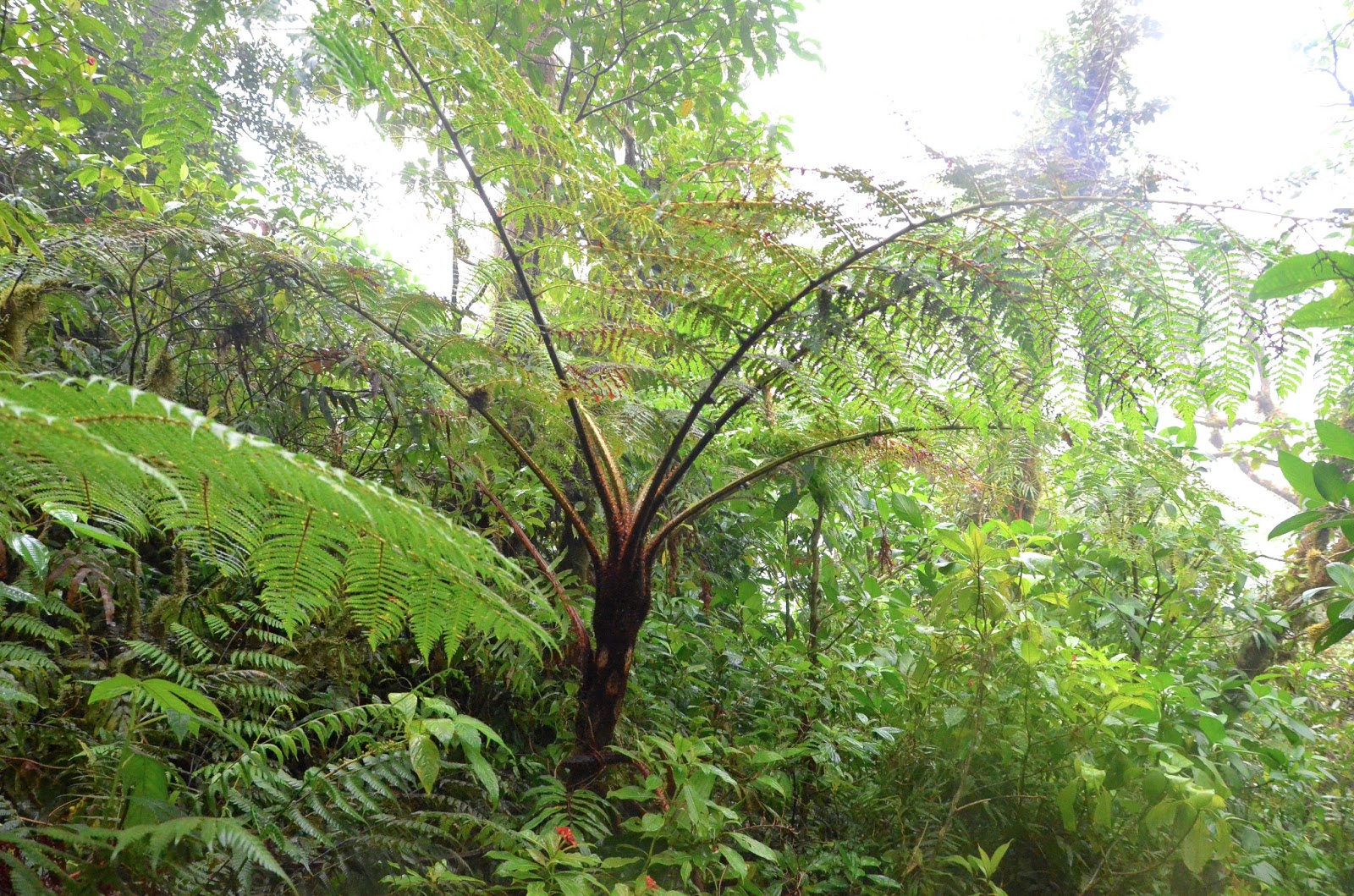
 Valerie is just over 5' tall, so these leaves have a solid 4' blade, almost 6' from stem to tip.


Tree fern!


The trail got crazy steep in places. It was all mud, sometimes just a slick surface, sometimes 6" deep, and a mix of roots or rocks or both.

 And yet just 2 days earlier there was the Fuego y Agua ultramarathon on these slopes. The 100k running race actually ran up to the top of Volcan Conception (5,200ft), then back down to lake level (100 ft), ran along the beach for several miles to Volcan Maderas (4,500 ft) back down again, then across the island again to the start. Muy Loco! I am told they mostly walked/hiked on the steep mountain slopes since it was too difficult to run. But still, loco. This area was called the Elf Forest BTW, I think cause the trees were relatively short.

Finally we descended the even steeper trail into the caldera of the dormant volcano. Scrambled down really. Where we had lunch by the shore of the lagoon. The clouds whipped past above us and swirled in the strong winds, forming as the slope of the mountain pushed the moist air up to cooler elevations where they would condense into clouds. Our lunch break was about 30 minutes long. There aren't many better places for a lunch break.


 Took a photo up there of a horizontal tree branch with just a few epiphytic plants growing on it. I had been shooting with my good camera up to this point, but the trail was so difficult I decided to stash it away in my backpack for the hike back down. This turned out to be a very good decision, but I don't have as many photos from the rest of the hike

 Fortunately for us, they had installed some posts with ropes between them on the trail into/out of the caldera. These were great aids on the climb back up. It may not have been possible without them.

The hike up the mountain wasn't really that hard. I got a cramp in one calf, but I was able to suck it up and get up there anyway. The hike down on the other hand, was, probably the most difficult hiking I have ever done. It was very, very slippery, and rough with the rocks and the roots, and very steep. That and I was wearing my Vibram Five Finger "toe shoes". Whiles these offer a lot of toe flexibility, they have virtually no padding and also almost no tread depth. So I was sliding all over the place on the way back down. I had to grab from tree to tree to support myself, and every big step down pounded into the bottom of my soft gringo feet.


Had to take a couple breaks on the way down, my legs were quivering with fatigue. The third rest stop we did down at the coffee plantation. Where we spotted some white-headed capuchin monkeys in the distance, so I pulled my good camera out of my bag and got some pretty good shots. But for the life of me I can't remember what the locals called the capuchins.

Here a couple other hikers stumbled down the mountain behind us. Both seemed like dirty hippy backpackers. The first spoke Spanish, but very little English, the guy with him spoke very little Spanish though which was odd, instead being a native English speaker. Also, he did the hike barefoot, which he reported was miserable. No doubt.
 
Our last rest stop was at the first view point, and got some good photos on this unusually clear day.


In the end, I have to say this ~10 mile hike was the most difficult one I have ever done. I heard from more than one local that it was only 8km (~5 miles) round-trip, but measuring it out on the map its pretty clear it was around 10 miles total.

Still, the relatively short distance belies the intensity of the experience: I have hiked to the top of a couple 12,000 ft, 13,000 foot, and even a 14,000 foot mountain. I've hiked the Grand Canyon from rim to rim in a day; 26 miles and a mile down followed by a mile up. The hike up Maderas was notably more difficult than that any of these. My legs and feet have never been so completely 'destroyed' after a hike, my legs have never felt that tired in my life. I could hardly walk uphill/stairs or downhill/stairs for 3 days, and I can still feel the soreness from the hike 6 days later, particularly in my calf where I got the cramp. With that said, its the middle of winter for me so I'm probably not at peak fitness (there were two young Chilean sisters who seemed to fly both up and down the mountain without effort, which didn't make me feel any better about my conditioning).

My choice of footwear was poor (though they were great for everything else we did on this trip) and I'm sure this contributed significantly to my difficulty in descending... good hiking boots would have gotten some grip in the mud and provided cushioning for my feet, in all they might have halved the effort of the descent. Still, I didn't have the worse shoes on the mountain that day:

The Swiss girl these shoes belonged to told me that though they were old shoes, they started the hike in one piece, without any duct tape on them.

In any event, we were all happy to be back at the Hotel/Hostel Santa Cruz. We took icy cold showers and scrubbed as much of the tenacious clay mud off us that we could, which is to say we got about half of it off of us. Val and I ate an early dinner and went to bed by 8 or 8:30.